

JVET CONFERENCE 2027
15 - 17 July 2027; Oxford, UK
17th International Conference

Call deadline: 10 December 2026
Outcome decisions: 31 January 2027
Graduate bursaries: Five available for event fees and travel. Apply during the abstract submission process.
Conference format: In person
JVET Conference 2027, your invitation…
Join JVET at our 17th International Conference in Oxford, 15 - 17 July 2027.
We are delighted to announce that the call for abstracts for our 17th International Conference is now open.
The Conference to be held 15 - 17th July 2027 in Oxford UK, will welcome keynote speakers including Åsa Broberg, Stockholm University and Ann-Marie Bathmaker, University of Birmingham.
This coming conference shines a spotlight on technological challenges, economic disruption and social crises.
As the call outlines:
VET is often seen as the solution to various societal challenges, though one fraught with problems. Yet promised transitions to digitised and more sustainable societies have increasingly been displaced by concerns about the unpredictable consequences of AI, the technologies of war and the consequences of migration, driven by conflict and global warming. In a world of accelerating inequalities, disadvantaged young people and adults who find themselves in VET are inevitably the most affected. And frequently, attempts to reform VET systems complicate the roles of VET workers.
The call is now open to all contributions that seek to enrich this field of enquiry. Read the full call and submit here.
Meet JVET Conference 2027 speakers…

Åsa Broberg
Associate Professor, Education at the Department of Education, Stockholm UniversityÅsa Broberg is Associate Professor of Education at the Department of Education, Stockholm University. Her research focuses on the history of education, particularly vocational education and training (VET). She examines how educational opportunities, vocational pathways, and participation have been shaped by broader social, political, and cultural processes. Her work highlights the historical dimensions of issues that remain central to contemporary discussions of vocational education and training.
She is currently involved in two major projects: From Workforce Immigration to Inclusion, which explores the role of VET in labour market integration and social inclusion, and History of Vocational Education and Training for Women: Multinational Commentaries, an international edited volume to be published by Springer in 2027 that examines the historical relationship between women's access to vocational education and social change.

Professor Emerita of Vocational and Higher Education at the University of Birmingham. Ann-Marie Bathmaker
Ann-Marie Bathmaker has been involved in research into the fields of vocational and higher education for the past 30 years, in particular understanding and addressing questions of equity and inequality in educational provision in these contexts. Her work has focused on the Further/Higher Education interface, governance in further education, teaching and learning in vocational and higher education, professionalism and professional identities in further education as well as Higher Education and social class.
She is Chair of the Singapore SkillsFuture Expert Review Panel for Workforce Development Applied Research; member of the Editorial Management Committee of the Journal of Vocational Education and Training (JVET) and former editor of the journal (2017-2021); a trustee of the Edge Foundation (a UK based education charity with a particular focus on technical and professional education). She was previously the specialist advisor to the House of Lords Select Committee on Social Mobility School to Work (2015-2016), and Extraordinary Professor at the University of the Western Cape, South Africa.
Celebrating JVET’s 250th Edition
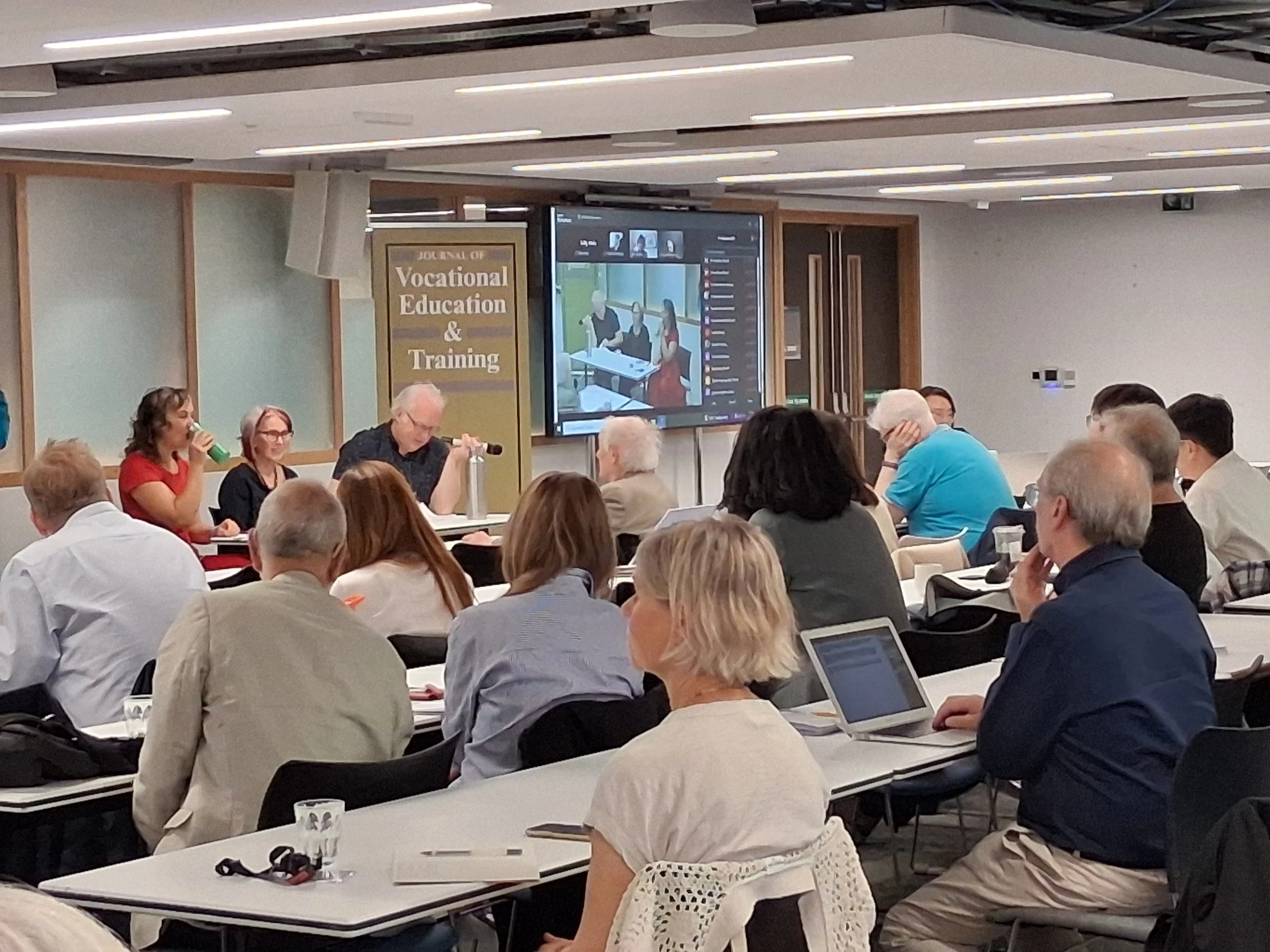
With our thanks to colleagues from around the globe who joined JVET and the LLAKES Institute, in person and online, on Friday 22 May 2026 to celebrate JVET’s 250th Edition.
To mark the event, JVET hosted two lively debates. The first debate focussed on The Capabilities Approach, and was chaired by Simon McGrath with Leesa Wheelahan and Stephanie Allais putting forward their viewpoints. The second debate was chaired by Moses Oketch and presented arguments by Markus Maurer and Bill Esmond.
With over 50 people in person and over 100 joining the event online, the JVET team was delighted to host the event and welcomed the range of diverse views, comments and viewpoints explored throughout the day. It was an great showcase for the JVET community to come together and examine key theories, the challenges and the future shape for VET. With our thanks to all that attended this celebratory event and for the lively participation and feedback received.
View the event recordings here…
Didn’t make the event? Don’t miss out! Catch up with the event recordings.


Leesa Wheelahan and Stephanie Allais present:
Debate 1: The Capabilities Approach
View the presentation


Markus Maurer and Bill Esmond present:
Debate 2: Institutional Economy
View the presentation

Event book launch:
View the presentation

Welcome and LLAKES presentation:
View the presentation